We've gotten so much great feedback on Operation Pollinator in the last week!
Turfnet correspondent John Reitman featured Operation Pollinator in an article about pollinator conservation and colony collapse disorder!
http://www.turfnet.com/page/news.html/_/creating-a-buzz-r139
Katie Pratt wrote a news release for the College of Agriculture that has been featured on several websites so far!
http://uknow.uky.edu/content/uk-research-focuses-bringing-back-pollinators
http://news.ca.uky.edu/article/uk-research-focusing-bringing-back-pollinators
Jeff Frankin produced a short TV spot on Operation Pollinator for the College of Agriculture!
http://news.ca.uky.edu/video/operation-pollinator
And Dr. Potter and I were just interviewed for a radio spot by Mike Feldhaus, a producer for Across Kentucky!
We are so grateful for all the public interest in our project. I truly hope we can use our current surge in publicity to increase awareness of pollinator decline and encourage the creation of new pollinator conservation sites like Operation Pollinator!
Showing posts with label Extension. Show all posts
Showing posts with label Extension. Show all posts
Wednesday, June 26, 2013

Tuesday, June 25, 2013
Operation Pollinator's Youtube Debut!
We're famous!
I just realized that I am not into hearing my own recorded voice. Has anyone ever not had that reaction?
I just realized that I am not into hearing my own recorded voice. Has anyone ever not had that reaction?
Wednesday, June 12, 2013
Field day, chartreuse shirts, and lots of new blooms.
Tomorrow is the annual Turfgrass Field Day at the AJ Powell Turf Research Station, where several hundred turf managers, horticulturalists, greenhouse operators, landscapers, highway maintenance people, and anyone else connected to the turf and landscape industry come together for a long day of continuing education.
My lab loves Field Day.
Field Day for us consists of a hanging out in the great outdoors, giving lectures on our research, and interacting with the end-users for the data we produce. We are able to give people advice for managing pests in the urban landscape, and we usually get very valuable feedback from the crowds with whom we speak.
We also get free donuts, coffee, and lunch, which is always delicious and very welcome.
And.
New turfgrass science shirts for all the presenters, which have ranged in the past from slick, black athletic shirts, to gray T-shirts, to this year's choice, delivered today: chartreuse polos.

The color isn't really coming through in all its super-bright glory, so here's an example which more accurately reflects the color of the matching shirts that my lab of six grown adults will be wearing:
 |
| Photo credit: Mark-Anthony and Christine Rice |
It might be a grumpy troupe of six adults wearing the same chartreuse shirts tomorrow morning.
ANYWAY
The plots are going to be on full display tomorrow morning to about three hundred people, and they are looking good.
New species blooming right now:
Prairie coneflower


Purple coneflower


Black-eyed Susan


And plains coreopsis!

The bergamot is getting ready to start putting out its first lilac tendrils!

We even had a few visitors, like this Speyer's cucullia caterpillar. I was initially fooled in my excitement into thinking this was a Monarch caterpillar, but quickly realized that I would never find a Monarch on fleabane (pictured here), but only on milkweed.

BUT
I did find an adult Monarch happily foraging on lance leaf coreopsis!

All of this is very exciting for me and my lab, and I can't wait to show off the plots to the public tomorrow morning.
Even if the only thing more colorful than the Operation Pollinator plots will be our shirts.
Wednesday, May 8, 2013
Greenhouse seedlings and new buds
In an effort to learn to ID my wildflowers before they bloom, I am attempting to grow some of them in our greenhouse. I am not known for my green thumb, so this should be a fun adventure.
Our seeds come from a great company called Applewood Seed, based in Arvada, CO. They have been extremely helpful in choosing which wildflowers would work best for low-maintenance plots in Kentucky.
And their seed bags are delightfully colorful:
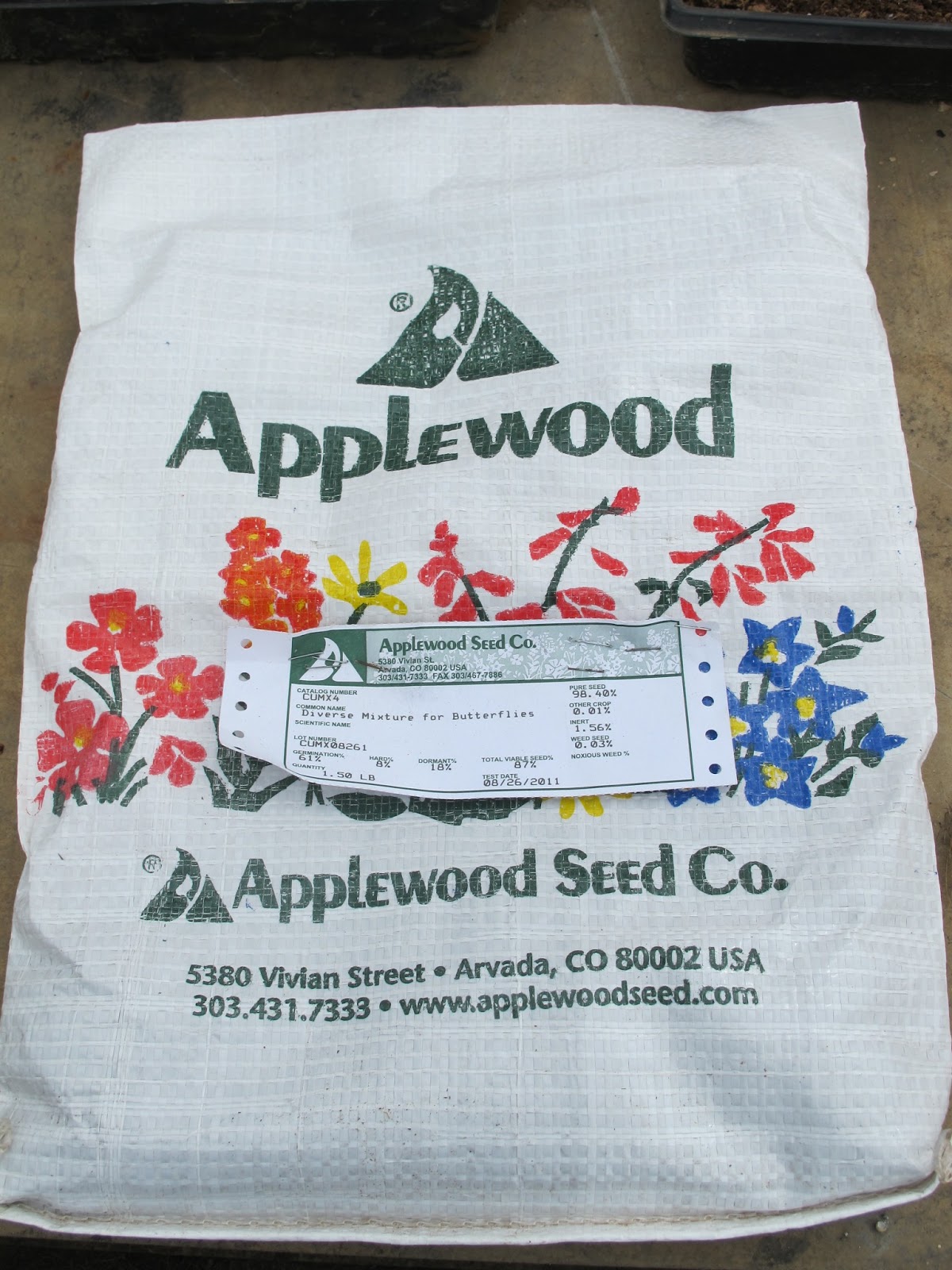

And here's the three planted wildflower seed mixes:

We'll see how this works out...
In the meantime, the Operation Pollinator plots are full of buds! The lance-leaf coreopsis looks ready to burst into bloom within the next week!


Our seeds come from a great company called Applewood Seed, based in Arvada, CO. They have been extremely helpful in choosing which wildflowers would work best for low-maintenance plots in Kentucky.
And their seed bags are delightfully colorful:
Here's what the butterfly seed mix looks like:
In the meantime, the Operation Pollinator plots are full of buds! The lance-leaf coreopsis looks ready to burst into bloom within the next week!
The purple coneflower is a long way from its dominant period, but I spy a single flower bud!
And the plots overall are looking pretty darn verdent!
There were even a few friendly predators living nearby, though I haven't seen very many pollinators out yet this year.
I am about to leave on a business trip to Syngenta's headquarters in Basel, Switzerland, so there won't be any regular updates on bloom progression for a few weeks. My very hardworking undergraduate technician will be taking lots of pictures and keeping me updated, and I'm very jealous that I won't be here to see the first wave of blooms. I will make sure to take lots of pictures as soon as I get back!
Thursday, May 2, 2013
Lexington Herald Leader Article!
Thanks to everyone for all the ongoing support!
My research and Operation Pollinator appeared in yesterday's Lexington Herald Leader, and I've been getting a lot of positive feedback from the community here at UK and throughout Kentucky.
Here's the link:
UK student plants golf course gardens to increase bee, butterfly populations
Knowing that my work may actually impact conservation awareness (and maybe even practice!) makes all of this worth it.

Thanks again!
My research and Operation Pollinator appeared in yesterday's Lexington Herald Leader, and I've been getting a lot of positive feedback from the community here at UK and throughout Kentucky.
Here's the link:
UK student plants golf course gardens to increase bee, butterfly populations
Knowing that my work may actually impact conservation awareness (and maybe even practice!) makes all of this worth it.
Thanks again!
Thursday, April 11, 2013
Golf Course Management Features Operation Pollinator!
I am a very, very lucky entomologist, folks. Golf Course Management, a trade journal published by the United States Golf Association, featured an article I wrote about Operation Pollinator.
This is big, big news for me, because every registered golf course superintendent in the US is subscribed to GCM. That's about 16,000 people. We've been getting some really positive feedback, and it feels fabulous.
Here's the link: http://gcmdigital.gcsaa.org/i/118283/112
Yay!
This is big, big news for me, because every registered golf course superintendent in the US is subscribed to GCM. That's about 16,000 people. We've been getting some really positive feedback, and it feels fabulous.
Here's the link: http://gcmdigital.gcsaa.org/i/118283/112
Yay!
Tuesday, June 26, 2012
We're famous!
Operation Pollinator was written up on Turfnet.com!
The story!
It's not a perfect article. I've participated in these things before for the lab, and they are always a little bungled. I don't think that a single one of those quotes isn't heavily paraphrased.
Also, my Liberal Arts senses. They tingle. Writing is a skill. I'm not trying to pronounce myself an excellent writer, I just wish that we had a few more technical writers that could piece together sentences with some degree of craft.
I see plenty of these excellent writers in the blogs that I regularly read, and I know many of them are scientists or work in a technical profession. Why isn't this skill--a skill that is clearly evident through their non-academic writing!--something that is prized, slapped at the top of C.V.'s, and encouraged in scientific journals?
Academia, you slay me.
The story!
It's not a perfect article. I've participated in these things before for the lab, and they are always a little bungled. I don't think that a single one of those quotes isn't heavily paraphrased.
Also, my Liberal Arts senses. They tingle. Writing is a skill. I'm not trying to pronounce myself an excellent writer, I just wish that we had a few more technical writers that could piece together sentences with some degree of craft.
I see plenty of these excellent writers in the blogs that I regularly read, and I know many of them are scientists or work in a technical profession. Why isn't this skill--a skill that is clearly evident through their non-academic writing!--something that is prized, slapped at the top of C.V.'s, and encouraged in scientific journals?
Academia, you slay me.
Wednesday, June 20, 2012
Funding and Field Day
Oh man has it been a busy week.
The meeting with the Syngenta folks went really well. It's always nice to get an outsider's perspective with these things, and the two guys who came down were full of helpful suggestions and provoking questions.
Also, they agreed that the whole thing was money well spent. Phew.
Since that meeting last Wednesday, I've also been busy collecting the bee bowls I put out last week, doing some wildflower species-specific pollinator collections, and speaking at the annual Turfgrass Field Day put on by my university's Plant and Soil Science Department.
I love Field Day. I really, really love Field Day. I get to speak to a ton of people, most of whom actually want to be there, on a topic I'm wild about. Several hundred laypeople show up to this event to get their CEUs (Continuing Education Credits) so that they can continue to commercially spray herbicides, pesticides, and fertilizers and run their horticulture/turf based businesses: nurseries, landscapers, lawn care applicators, etc. My lab always participates by running one of the "tours" where we talk about current issues in turfgrass management and our own research. It's refreshing to speak to people who are excited about the practical applications of my research and rarely question my methodology, statistical analysis, or whether I really think the literature supports my leading hypothesis. Academics. Whattayagonnado?
And did I mention it's outside? It's outside. Field Day is a beautiful thing.
And did I mention they feed us? They feed us. They even provided Boca burgers for us vegetarians. Field Day is a beautiful thing.
Here's my lab, all pumped up and happy to be talking to these folks. We talked for about one hour collectively, though each individual's presentation varied in length. I was feeling chatty and excited, so I might have taken a little bit more time than the rest of the group...


The meeting with the Syngenta folks went really well. It's always nice to get an outsider's perspective with these things, and the two guys who came down were full of helpful suggestions and provoking questions.
Also, they agreed that the whole thing was money well spent. Phew.
Since that meeting last Wednesday, I've also been busy collecting the bee bowls I put out last week, doing some wildflower species-specific pollinator collections, and speaking at the annual Turfgrass Field Day put on by my university's Plant and Soil Science Department.
I love Field Day. I really, really love Field Day. I get to speak to a ton of people, most of whom actually want to be there, on a topic I'm wild about. Several hundred laypeople show up to this event to get their CEUs (Continuing Education Credits) so that they can continue to commercially spray herbicides, pesticides, and fertilizers and run their horticulture/turf based businesses: nurseries, landscapers, lawn care applicators, etc. My lab always participates by running one of the "tours" where we talk about current issues in turfgrass management and our own research. It's refreshing to speak to people who are excited about the practical applications of my research and rarely question my methodology, statistical analysis, or whether I really think the literature supports my leading hypothesis. Academics. Whattayagonnado?
And did I mention it's outside? It's outside. Field Day is a beautiful thing.
And did I mention they feed us? They feed us. They even provided Boca burgers for us vegetarians. Field Day is a beautiful thing.
Here's my lab, all pumped up and happy to be talking to these folks. We talked for about one hour collectively, though each individual's presentation varied in length. I was feeling chatty and excited, so I might have taken a little bit more time than the rest of the group...

I've got to cure myself of this. I talk with my hands. I look like a wimpy velociraptor.

And we were lucky enough to do the tour right in front of my Operation Pollinator plots, so extra publicity for me!

I love how enthusiastically people respond to these presentations. I did two interviews on the spot--one for Turfnet.com, the other for the Plant and Soil Sciences web designer. I'll link to them if they ever are published.
The whole thing turned out to be totally worth the wicked sunburn I picked up on the backs of my legs.
Though not by much. Sunburns are the worst. Especially in the crinkly part of your knees.
Subscribe to:
Posts (Atom)